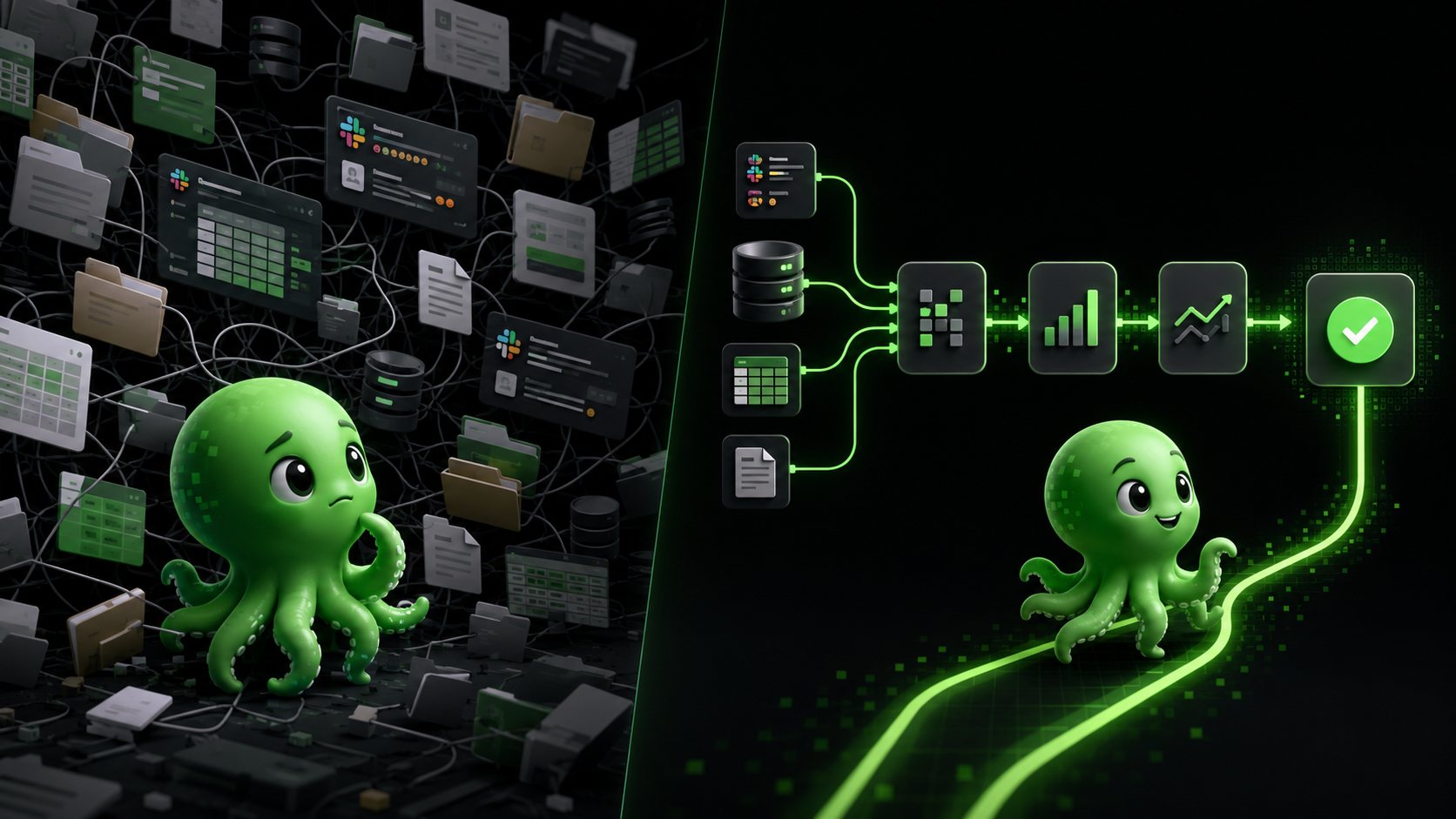
There is a myth I hear constantly about AI:
I am going to give it everything about my business, and it will figure the rest out.
Connect the company Drive. Connect Slack. Connect the warehouse. Add every available MCP server. Now the AI has everything, so it must understand everything.
This is a terrible plan.
It can produce a cool demo. Ask for a summary of one document and the result may feel magical. Ask a simple question whose answer appears clearly in a well-named file and it may work immediately.
But that is not the same as understanding your business. It is not even close.
AccessAccess is not understanding
Imagine a new hire on their first day.
You give them access to Google Drive. Inside are 10,000 documents: strategy decks, abandoned plans, meeting notes, financial models, old policies, customer research, duplicated spreadsheets, and files whose names made sense only to the person who created them three years ago.
Does the new hire now understand the company?
Of course not. They have permission to look. That is different from knowing what matters, what is current, how concepts relate, and which source should be trusted when two files disagree.

AI works much more like that new hire than most people realize.
When you connect an AI to Drive, you are not pouring the contents of Drive into its brain. You are giving it a way to search Drive. For a particular question, the system tries to find relevant files, opens some of them, extracts useful passages, and puts those passages into the model's temporary working context.
That is why Google's own documentation describes Gemini in Drive in terms of searching and retrieving files, choosing active sources, and citing the files used in an answer. Google also warns that when a folder contains many files or subfolders, Gemini may not incorporate every file in its response (Google Drive Help).
The AI has a library card. It has not read and internalized the library.
RetrievalWhat actually happens when you ask a question
The exact implementation varies, but a typical company-knowledge assistant does something like this:

This general approach is called retrieval-augmented generation, or RAG. The foundational RAG paper describes a model combining its learned, parametric memory with a separate searchable index of external documents (Lewis et al., 2020).
Retrieval is useful. It is also a funnel. At every step, information can be lost.
The system has to translate your question into a search. It has to choose the right repository. It has to rank the correct file above thousands of plausible but irrelevant files. It has to extract the right section. Then the model has to interpret that section correctly alongside everything else in its context.
If the answer depends on a connection that was never written down, a definition buried in code, a decision made in a meeting, or a newer file with an unhelpful name, access alone will not save you.
Even loading far more material is not a complete solution. Research on long-context models found that their ability to use relevant information can change significantly based on where that information appears, with performance often falling when the important passage sits in the middle of a long input (Liu et al., 2023). A large context window is capacity, not comprehension.
ScaleBillions of dollars do not make this problem disappear
Apple and Google have both invested heavily in systems that draw on personal or company context.
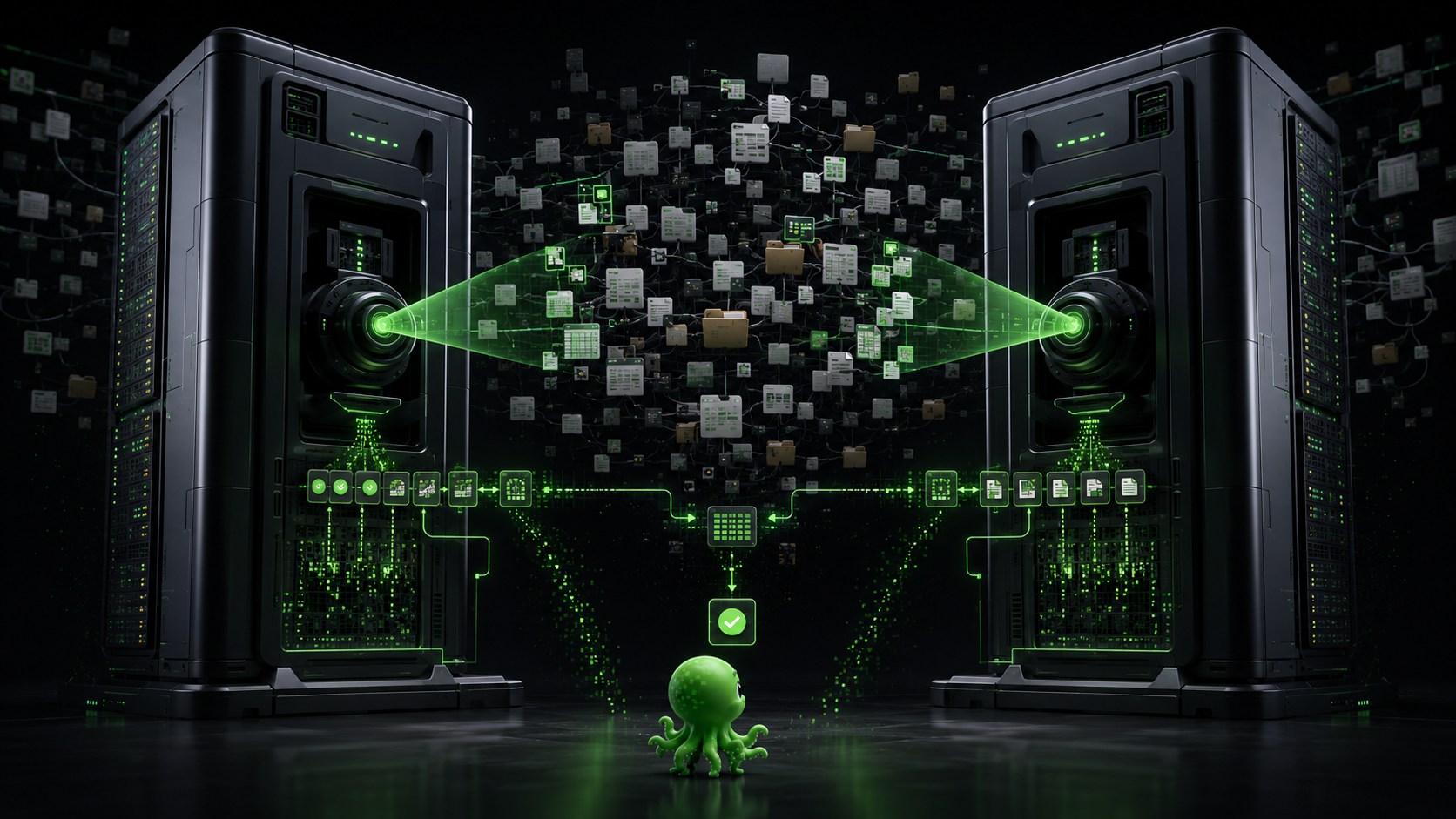
Apple introduced Apple Intelligence as a system that could draw from information across apps to answer personal questions and take actions (Apple). Google's current Drive product lets Gemini search across Workspace, assemble selected files into projects, and answer with citations (Google Drive Help).
These products can be useful. They also reveal how hard the problem is.
Neither company treats “the AI can access everything” as a sufficient architecture. Their products search, scope, select, retrieve, index, cite, and ask users to define sources. The enormous engineering effort is in deciding what context should be available for a specific request and how the system should find it.
If companies with enormous budgets cannot make open-ended context trivial, connecting your company's messiest shared drive to a generic chatbot will not do it either.
ToolsMore connections can create more confusion
The same mistake appears with tools.
MCP makes it possible to expose applications and actions to an AI. That is valuable. But giving an agent 1,000 tools does not mean it knows when to use each one, which tools overlap, what sequence is safe, or which result is authoritative.
Anthropic has documented this problem directly. It found that tool definitions and results can consume more than 50,000 tokens before an agent even begins the actual task, and that common failures include choosing the wrong tool or supplying the wrong parameters when tools look similar (Anthropic).
A toolbox is not expertise.
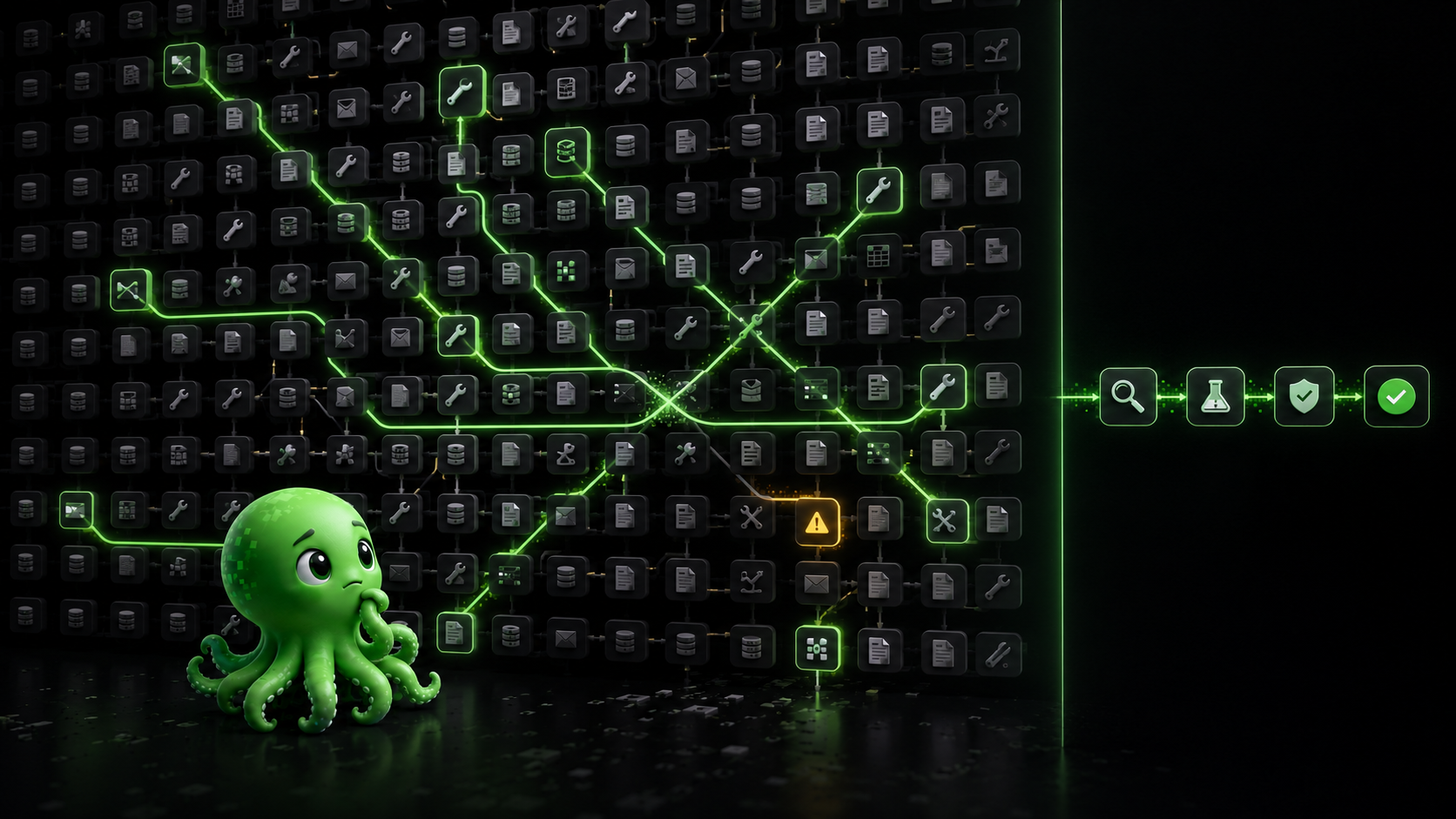
A master mechanic is useful not because they carry every possible wrench. They are useful because they understand the machine, recognize the failure pattern, know what to inspect first, and can tell when the evidence contradicts the initial hypothesis.
That operating model is what a good AI system needs.
DomainGive the AI a domain, not a dump
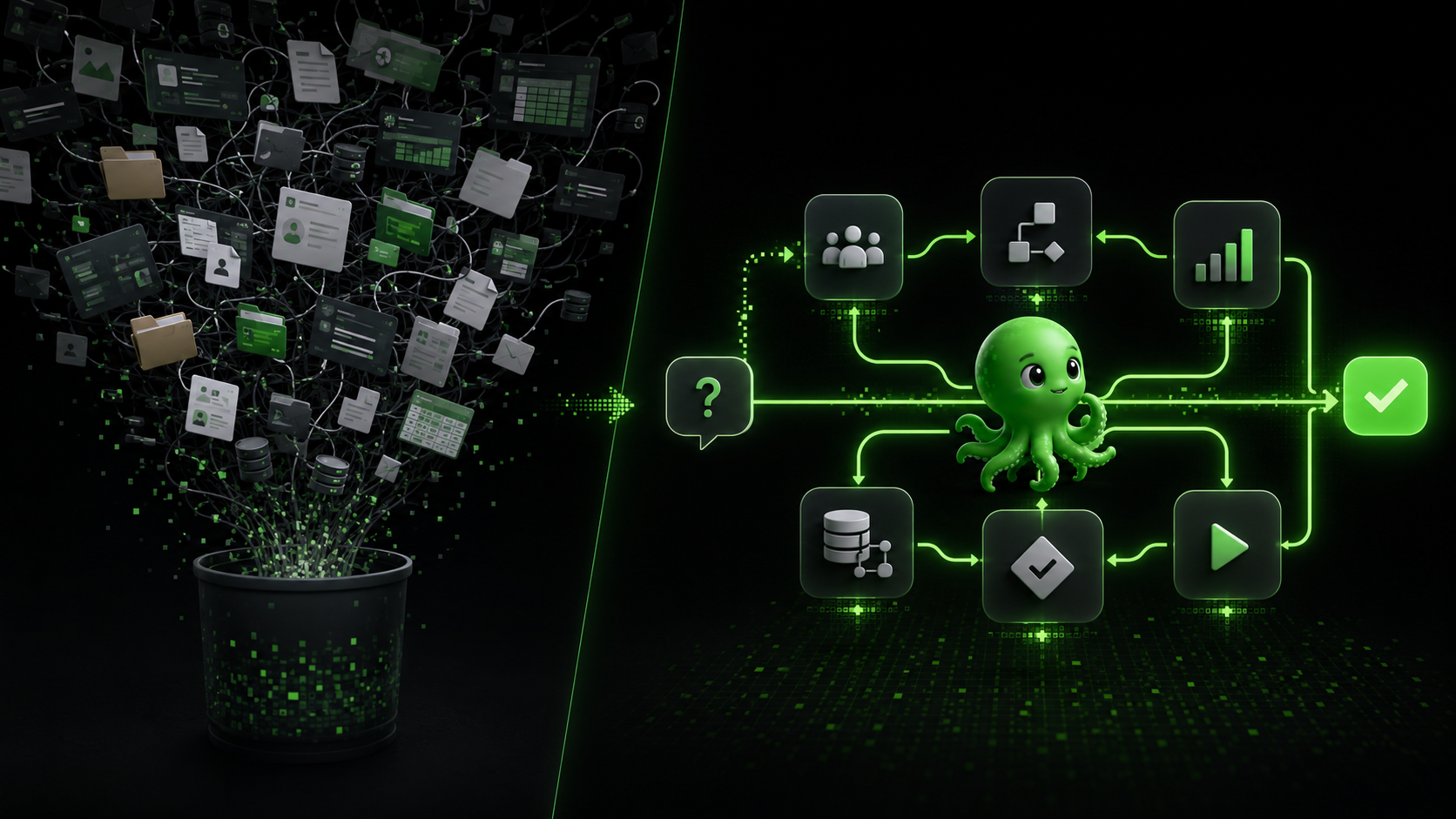
The better approach is to choose a domain and teach the system how that domain works.
For marketing, that might mean explicitly connecting the brand, audiences, campaigns, assets, approvals, performance, and publishing workflow. The system should know which voice guide is current, which claims are approved, how an asset relates to a campaign, and where performance data comes from.
For customer support, it might mean connecting the customer, product, account state, conversation history, known incidents, escalation rules, and available actions.
For data, it means understanding the pipeline:
business question
      ↓
metric definition
      ↓
model and transformation logic
      ↓
lineage and processing state
      ↓
warehouse data and source freshness
      ↓
decisions, incidents, and company context
The point is not to hide information from the AI. The point is to give the information structure: stable concepts, explicit relationships, retrieval paths, permissions, validation, and a clear idea of what success means.
OpenAI's description of its internal data agent is a useful real-world example. The agent does not simply scan the company's warehouse and hope. It uses multiple designed layers: metadata and lineage, historical query patterns, human annotations, code-level definitions, institutional knowledge from documents and messages, saved corrections, and live warehouse queries. At runtime, it retrieves only the relevant context instead of scanning raw metadata and logs (OpenAI).
That is domain expertise made operable.
PolyformThis is what we designed Polyform to do
Data is especially unforgiving because the truth rarely lives in one file or table.
To answer a question correctly, an agent may need to understand what a metric means, how events become activities, which transformations produced it, whether the source is fresh, what the user is seeing in a report, and whether a known issue already explains the anomaly.
Polyform gives the agent that map.
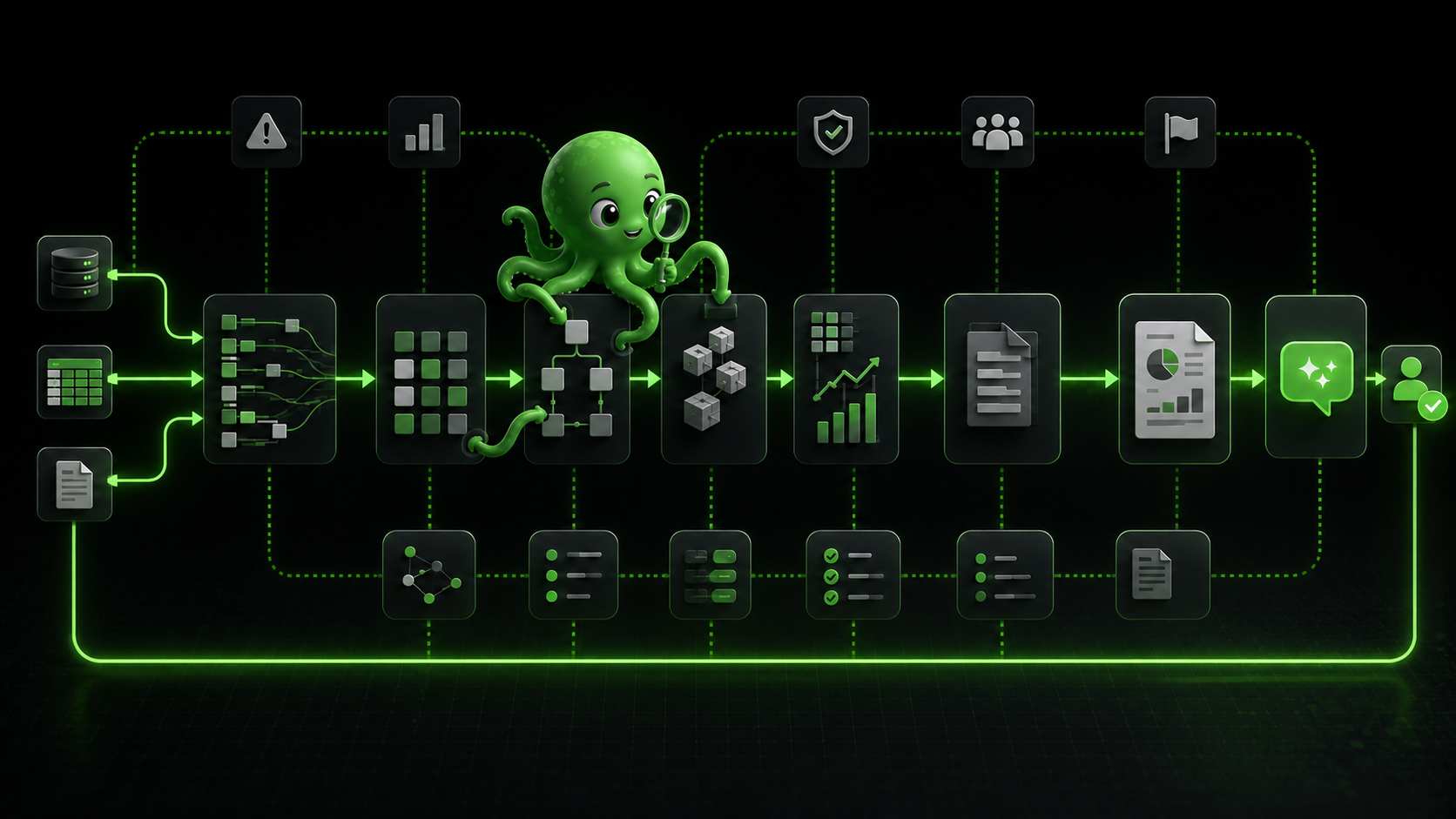
We organize data around business activities and preserve the relationships from sources through transformations, metrics, analysis, and AI applications. The agent does not receive a random bag of database actions and documents. It operates inside a system designed around how data work actually happens.
We deliberately control what information is available, how it is described, and how one object leads to the next. The agent can move up and down the chain, retrieve what it needs at the moment it needs it, and validate an answer against the underlying data.
That does not make the AI omniscient. It makes the AI useful.
Better questionStop asking whether the AI can access everything
Ask better questions:
- ✓What job is this agent responsible for?
- ✓What concepts must it understand to do that job?
- ✓How are those concepts connected?
- ✓Which sources are authoritative?
- ✓What should it retrieve first, and what should it inspect next?
- ✓How will it verify that the answer is true?
The companies that get real value from AI will not be the ones that connect the most data or install the most tools.
They will be the ones that turn their domain expertise into a system the AI can navigate.
Access gives the AI somewhere to look. Structure tells it how to think.

Access gives the AI somewhere to look. Structure tells it how to think.